


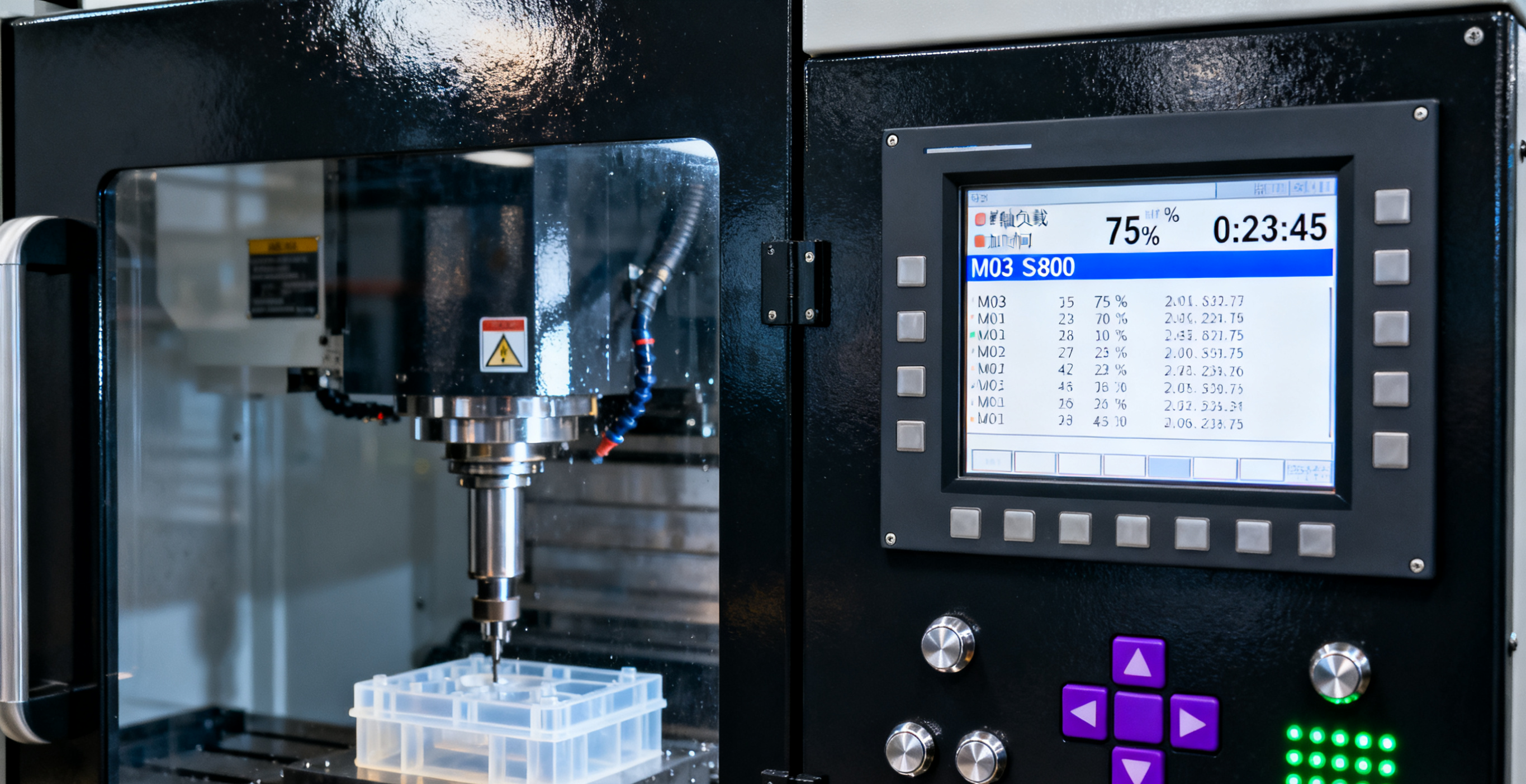
In micro milling machines, industrial displays serve as the core interface for human-machine interaction, undertaking key tasks such as real-time monitoring, parameter adjustment, and fault diagnosis. Their high reliability, environmental adaptability, and ease of operation are crucial for ensuring machining accuracy and efficiency. The following analysis is conducted from three dimensions: application scenarios, core values, and technological implementation:
1, Typical application scenarios of industrial displays in micro milling machines
Real time processing monitoring
When micro milling small parts (such as workpieces with a diameter of 0.1mm), it is necessary to present real-time parameters such as tool path, cutting force, and surface quality through a high-resolution display. For example, a five axis ultra precision micro milling machine uses industrial displays to display vibration data of omnidirectional air bearing guides, ensuring stability at spindle speeds (such as 200000 r/min).
Dynamic parameter adjustment
When the machining tolerance needs to be controlled within 0.1mm, the operator needs to quickly modify parameters such as feed rate and spindle speed through the touch screen. Industrial displays support multi touch (such as 10 touch) to achieve real-time parameter adjustment and reduce downtime.
Fault warning and diagnosis
When the tool wear or machine vibration exceeds the standard, the industrial display intuitively displays the fault location through a graphical interface (such as the 80 ° wide viewing angle of TopMicro LMT150DNGFWD-NNC-4), and predicts the tool life based on historical data to avoid machining interruption.
2, The core value brought by industrial displays to micro milling machine tools
Environmental adaptability ensures processing stability
Micro milling machines are often exposed to high temperatures and dust environments (such as metal shavings splashing). Industrial displays adopt a sealed design (IP65 protection level) and scratch resistant wear-resistant panels to prevent impurities from entering. For example, embedded industrial displays operate stably within the temperature range of -20 ℃ to 70 ℃, adapting to the temperature difference between day and night in the workshop.
High precision display supports micrometer level machining
When processing fine features at the 0.1mm level, the display should provide a resolution of 1024 × 768 or higher to ensure that the operator can accurately identify the positional tolerance at the 0.01mm level. TopMicro's industrial LCD module displays processing data clearly even under strong light with a high brightness of 400cd/m ².
Convenient operation improves efficiency
Capacitive touch screen (CTP) supports gesture operation and has a response speed of milliseconds, making it more durable than traditional resistive screens. The operator can quickly adjust the machining strategy by zooming, dragging, and other actions, such as switching between reverse milling and forward milling, to reduce human error.
3, Technical Implementation of Industrial Display in Micro Milling
Hardware Design: Robust and Accurate Balance
Structure: Adopting an all metal frame and seismic design, it can withstand machine tool vibration (such as impact during five axis linkage).
Interface: Supports industrial protocols such as LVDS and RS232, seamlessly integrates with PLC and DCS systems, and achieves real-time data transmission.
Lifespan: Rated for over 50000 hours, reducing replacement frequency and lowering long-term costs.
Software optimization: intuitive interaction and intelligent analysis
HMI interface: Customized graphical interface displays key data such as tool path and cutting load, and supports 3D model rendering.
Data analysis: Integrate CAM system to dynamically adjust feed rate based on actual machining allowance, protecting precision cutting tools.
Remote management: Remote monitoring is achieved through WIFI and 4G modules, allowing engineers to diagnose the status of machine tools remotely.
4, Case: Application of Industrial Display in Five Axis Micro Milling Machine Tool
A precision mold enterprise uses a five axis ultra precision micro milling machine to process optical lens molds, and its industrial display has the following functions:
Real time display: spindle speed, tool vibration, surface roughness (Ra 0.2 μ m level) and other parameters.
Fault warning: When the cutting force fluctuates by more than 5% due to tool wear, an alarm is automatically triggered and tool replacement is recommended.
Operation optimization: Quickly switch machining strategies (such as rough machining, semi precision machining, and integrated precision machining) through the touch screen, reducing machining time by 30%.
Conclusion: Industrial displays have become a key support for micro milling machines to achieve micrometer level precision machining through high reliability, environmental adaptability, and intelligent functions. Its value is not only reflected in data display, but also in optimizing the processing flow through human-computer interaction, promoting the manufacturing industry to move towards higher precision and efficiency.