


What Touch Technologies Are Used in LCD Capacitive Touch Screens?
In-Cell / On-Cell / OGS LCD Touch Screen Structures
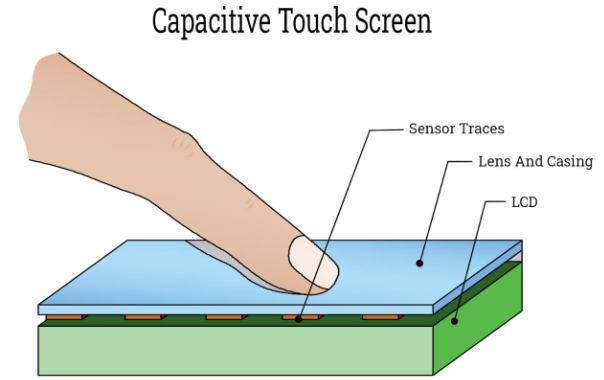
The basic structure of a typical LCD touch display consists of three layers: a protective layer, a touch layer, and a display layer. In standard displays, these layers are usually assembled using frame bonding, which leaves an air gap between the touch panel and the display screen. This air layer affects the display's clarity and thickness.
However, optical bonding removes the air gap by using adhesive (like OCA or OCR) to seamlessly bond the layers, reducing screen thickness, minimizing reflections, improving display transparency, enhancing black levels when the screen is off, and ensuring clarity even under strong light.
LCD Touch Screen Bonding Technologies
Optical Bonding: This process seamlessly bonds the display panel and the touch panel (or cover glass) using optical adhesive (e.g., OCA or OCR), removing the air layer entirely.
Frame Bonding: Also known as "border adhesive bonding," it uses double-sided tape around the screen's edges to stick the display and touch layers together, leaving an air layer in the center.
Difference Between Optical and Frame Bonding
Optical bonding offers better light transmission, less reflection, and a more durable, dust-resistant design, while frame bonding is easier and more cost-effective to produce.
Capacitive Touch Technologies: OGS, On-Cell, In-Cell
Leading display panel manufacturers are increasingly favoring On-Cell and In-Cell solutions, integrating the touch layer into the display itself. Meanwhile, touch module makers and upstream material providers often prefer OGS (One Glass Solution), where the touch layer is part of the cover glass.
1. In-Cell
In-Cell technology integrates touch sensors directly into the LCD pixel structure. This results in thinner, lighter screens. However, to avoid false touches and noise, In-Cell screens require dedicated touch ICs.
Advantages:
Thinnest screen structure
High stability (touch circuitry is embedded and protected)
2. On-Cell
On-Cell places the touch sensor between the color filter glass and polarizer of the LCD panel. It's easier to implement than In-Cell and offers a good balance of thickness and performance.
Advantages:
Easier to manufacture than In-Cell
Moderate performance and durability
3. OGS (One Glass Solution)
OGS integrates the touch sensor directly into the inner side of the cover glass by coating a conductive layer (ITO), followed by photolithography and etching. Since touch and cover glass are one, the glass must be strengthened before processing.
Disadvantages:
High manufacturing cost
Low yield rate
Cutting the strengthened glass can create micro-cracks, reducing durability
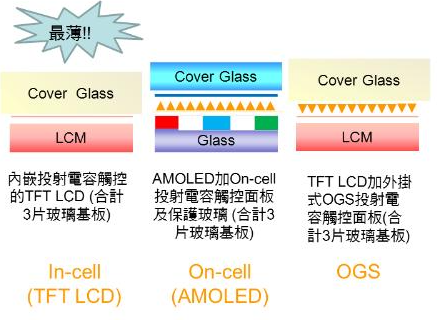
Comparison of In-Cell, On-Cell, and OGS Technologies:
Visual Transparency & Image Quality:
Best: OGS
Moderate: In-Cell, On-Cell
Thinness and Weight:
Best: In-Cell
Moderate: OGS
Heaviest: On-Cell
Impact and Drop Resistance:
Best: On-Cell
Moderate: OGS
Weakest: In-Cell (because touch/display are fused - if damaged, both must be replaced)
Touch Sensitivity:
Best: OGS
Moderate: On-Cell
Least Sensitive: In-Cell
Note: OGS may be too sensitive, prone to false touches from dust, moisture, or sweat. In-Cell needs advanced touch ICs to filter out high noise levels.
Technical Complexity:
In-Cell and On-Cell are more complex to manufacture than OGS and have higher production challenges and costs.
Yield Rate (Manufacturing Efficiency):
Initially, In-Cell screens had low yield rates (e.g., iPhone 5 production bottleneck), but with investment and maturity, their yield now matches that of On-Cell and OGS.