


When comparing 1000 nits vs 2500 nits displays, the main difference is light output. Under equivalent measurement conditions, a 2500-nit display has 2.5 times the luminance of a 1000-nit display. That additional brightness can help in strong daylight, but readability also depends on reflections, protective glass, installation angle, and sustained operating performance.
For buyers sourcing an industrial monitor, outdoor kiosk, or EV charging interface, the decision is rarely about brightness alone.
A higher-output display may solve a visibility problem. It may also change the power, cooling, and enclosure requirements. Before approving the upgrade, establish what users need to read and whether the complete display meets that requirement.
1. What Does the Nit Rating Actually Measure?
One nit equals one candela per square meter, written as cd/m². It measures luminance in a particular direction.
The number does not describe resolution, touch accuracy, weather resistance, or service life.
It also needs a measurement basis. A supplier may quote brightness for a bare LCD module, while another measures a finished monitor through its protective glass.
Ask whether the figure represents:
- Typical brightness or a guaranteed minimum.
- Bare-panel output or finished-display output.
- A brief peak or sustained operation.
- Center-screen brightness or multiple measurement positions.
Comparable quotations need comparable measurement conditions. Otherwise, the higher number may not describe the improvement you expect after installation.
2. 1000 Nits vs 2500 Nits: A Buying Comparison
|
Purchasing question |
1000-nit display |
2500-nit display |
|
Is it worth testing in a bright indoor space? |
Often a reasonable starting point |
Extra output may be unnecessary |
|
Can it work in a covered outdoor location? |
Possibly, with suitable shading and optical design |
Offers more output as daylight changes |
|
What about direct sunlight? |
Strong reflections may limit readability |
More brightness available, but testing remains necessary |
|
Does the glass still matter? |
Yes |
Yes |
|
Will power requirements change? |
Check measured operating power |
Check the complete design; no fixed power ratio applies |
|
What needs checking at night? |
Minimum brightness and adjustment behavior |
Minimum brightness and adjustment behavior |
|
When is the purchase justified? |
The sample meets the viewing requirement |
Extra output resolves a demonstrated visibility problem |
These are evaluation guidelines, not universal brightness thresholds. Neither rating establishes outdoor protection or suitability for continuous operation.
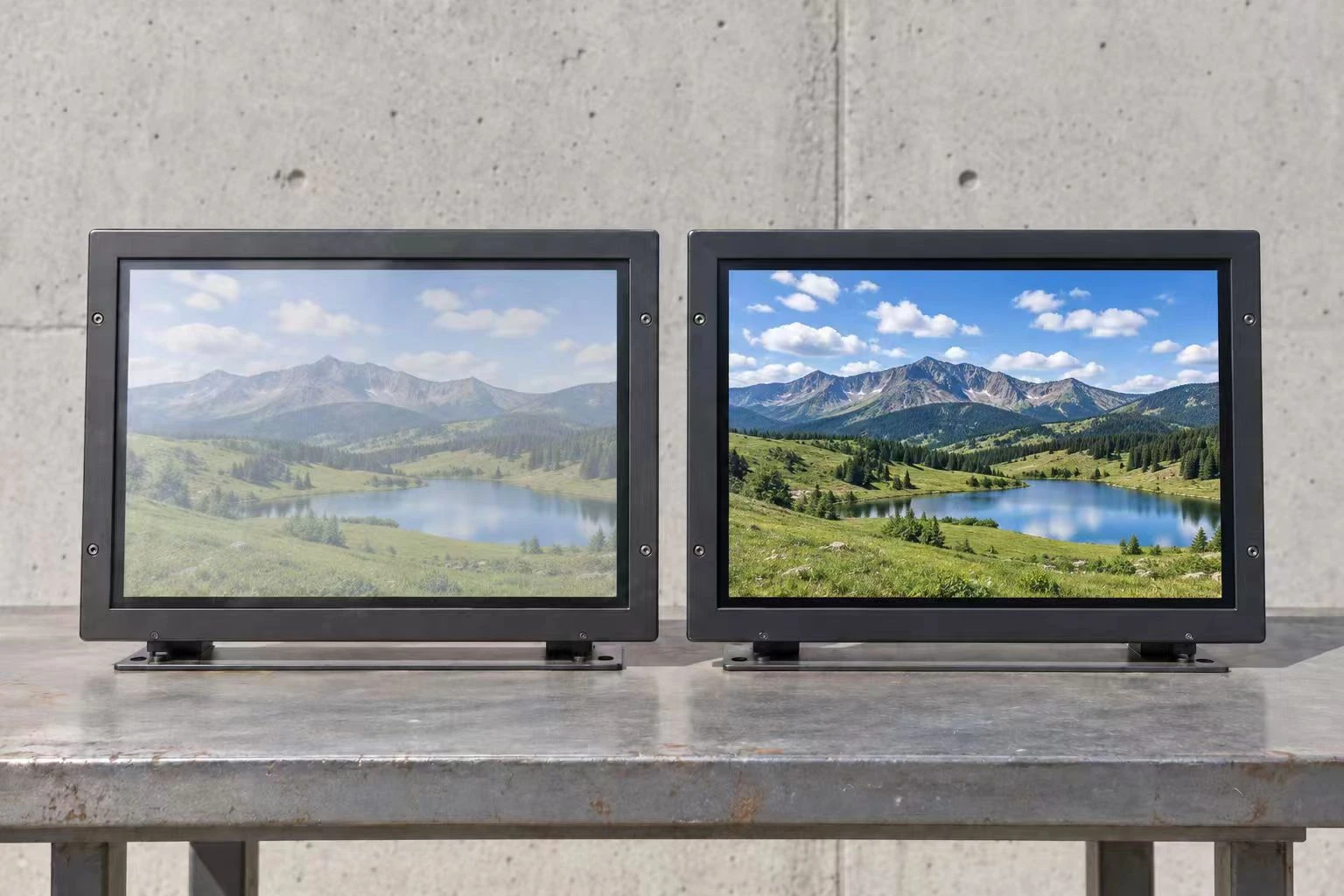
Use identical application content, comparable optical assemblies, and the same lighting and viewing angle. Lock camera exposure and white balance.
3. Is 1000 Nits Enough for Sunlight?
It can be enough in some installations. The useful distinction is whether sunlight and reflections prevent users from completing the required task.
A 1000-nit display is worth evaluating for an industrial control panel inside a bright building, a kiosk beneath a substantial canopy, or a recessed interface with effective shading.
Check the entire operating day. Morning shade does not guarantee afternoon shade.
Viewing distance and interface design matter too. Large, clearly separated controls viewed nearby are a different requirement from small labels read from several meters away.
Test the actual content. If users can read essential information under the agreed conditions, moving to 2500 nits may offer limited additional value.
If they cannot, investigate the cause. A bright reflection, weak text contrast, and insufficient screen output call for different improvements.
4. When Does a 2500-Nit Display Make Sense?
A 2500-nit display becomes more attractive when strong daylight makes essential content difficult to read and shading or mounting changes are limited.
Exposed charging interfaces, payment terminals, and outdoor information displays are examples worth evaluating.
More light output can improve the separation between displayed content and reflected ambient light. It does not eliminate reflections.
NIST's daylight-readability research includes illumination and display reflection measurements in the evaluation, rather than assessing emitted luminance alone. [1]
Ask the supplier to demonstrate the proposed sunlight readable monitor in conditions representative of your installation. A bright showroom or promotional photograph is insufficient evidence.
The upgrade should address a specific requirement, such as reading charging status from the normal viewing position during afternoon sunlight.
5. Optical Bonding and Glass Can Change the Result
For a high brightness industrial display, the front optical assembly belongs in the specification.
Optical bonding fills the air gap between the LCD and protective glass or touch layer. It can reduce internal reflections.
EIZO published a manufacturer comparison between a 350 cd/m² bonded maritime monitor and a 500 cd/m² non-bonded monitor. The bonded model maintained contrast above 10:1 up to approximately 12,500 lux. The non-bonded model fell below 10:1 at approximately 5300 lux. These results apply to the tested assemblies, not every bonded and non-bonded display. [2]
The comparison illustrates why a lower-luminance product can perform better under particular lighting conditions. It does not establish a universal replacement ratio between bonding and brightness.
Also distinguish anti-reflective treatment from anti-glare treatment. Anti-reflective treatment reduces reflection; anti-glare treatment scatters reflected light.
Request the glass and treatment specifications, then check small-text clarity and reflections on the sample.
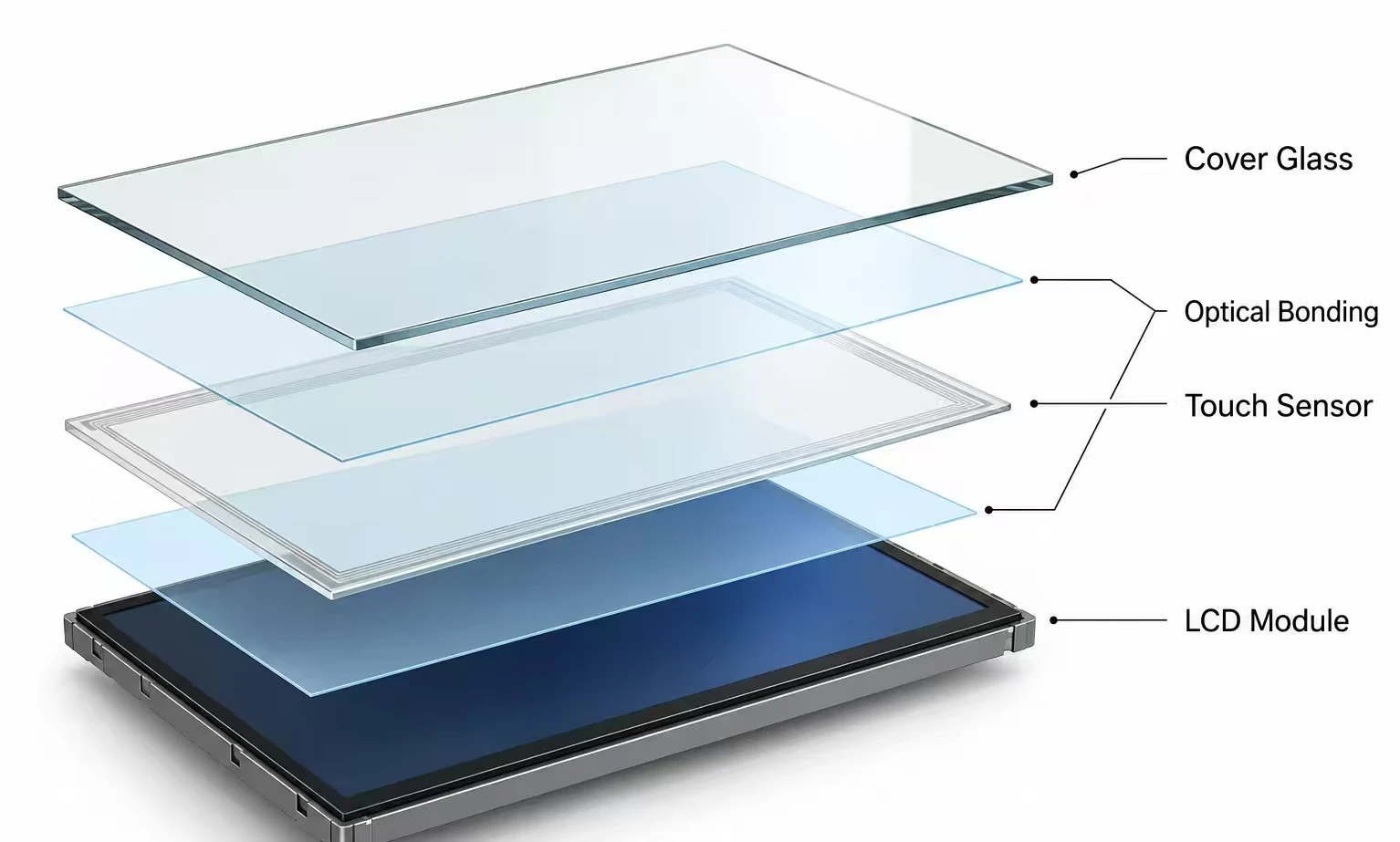
Show the LCD, touch layer, protective glass, and bonding position. Use short English labels.
6. Check Sustained Brightness and Thermal Behavior
An outdoor LCD brightness figure is useful only if the display can deliver the required performance during operation.
VESA DisplayHDR CTS 1.2 illustrates the difference between brief and sustained output. The DisplayHDR 1000 tier requires at least 1000 cd/m² in its full-screen flash test, but 600 cd/m² in its full-screen long-duration test. These are HDR certification criteria, not outdoor acceptance requirements. [3]
For an industrial display, request sustained luminance through the final optical assembly, the measurement temperature, and any conditions that trigger brightness reduction.
Test inside the intended enclosure until temperature and brightness stabilize. Record output, power, and operating behavior.
A wide operating-temperature range should not be interpreted as a guarantee of maximum brightness throughout that range.
Also check nighttime adjustment. A display selected for strong daylight needs an appropriate lower setting after dark.
7. How Hengstar Supports OEM Display Projects
For buyers comparing brightness options, Hengstar's relevant strengths are configuration flexibility, optical integration, and support from engineering evaluation through manufacturing. These capabilities should be assessed against your project requirements.
Application-specific customization
Hengstar supports customization of display size, brightness, touch configuration, interfaces, mounting, and enclosure design. [4] This lets buyers discuss the display as part of their equipment, including space constraints and connections, rather than selecting by luminance alone.
Brightness and optical integration
Hengstar offers high-brightness monitor products and optical bonding services. [5, 6] Buyers can therefore discuss panel output and the front optical assembly together. For a 1000-nit or 2500-nit requirement, confirm the available configuration and sustained performance in writing.
Mechanical and interface engineering
Hengstar describes support for mechanical design and display integration. [4] Provide mounting drawings, enclosure dimensions, and interface requirements early so compatibility can be evaluated before sample approval.
Development through production
Hengstar describes an integrated process covering prototype evaluation, production, testing, delivery, and after-sales support. [4] Agree on the approved configuration, project-specific checks, and component-change requirements before a bulk order.
The procurement value is the ability to discuss connected requirements with one supplier. Specific costs, lead times, test scope, and performance remain subject to the quotation and sample approval.
8. What to Put in the RFQ
Use a common specification so suppliers quote comparable solutions.
|
RFQ item |
Information to include |
|
Installation |
Indoor, covered outdoor, or exposed outdoor; orientation and shading |
|
Display |
Size, resolution, mounting dimensions, and orientation |
|
Brightness |
Minimum sustained value, measurement surface, and conditions |
|
Optical construction |
Touch panel, glass, bonding, and surface treatment |
|
Thermal environment |
Expected conditions and enclosure arrangement |
|
Electrical requirements |
Supply voltage, interfaces, and operating power |
|
Controls |
Automatic adjustment, manual adjustment, and minimum brightness |
|
Protection |
Requirements for the finished installed equipment |
|
Supply |
Sample configuration, lead time, warranty, and change notification |
Ask suppliers to identify deviations from the RFQ.
Separate front-surface protection from whole-device protection. The final equipment must meet the installation's environmental requirements.
Show the actual interface in daylight and demonstrate nighttime adjustment. State conditions, lock camera settings, and identify the footage as a demonstration rather than certification.
9. Compare the Installed Cost
Higher backlight output commonly increases power and heat in comparable LCD designs. Actual consumption depends on efficiency, screen area, optical transmission, and electronics.
Compare measured power and any changes to cooling, power supplies, enclosure space, and maintenance.
Choose 1000 nits when the approved sample meets the requirement. Choose 2500 nits when additional output provides a useful improvement and the equipment supports it.
Contact Us
Not sure whether your equipment needs 1000 nits or 2500 nits? Start with the installation conditions rather than a fixed brightness choice.
To request a configuration proposal and quotation, send Hengstar your display size, installation conditions, touch and interface needs, mounting drawing, and target sample or production quantity. Attach an existing specification or equipment photo if available.
Request an OEM Display Configuration and Quote
In your inquiry, ask for the proposed brightness and optical assembly, sustained-brightness conditions, sample pricing, MOQ, estimated lead time, and production configuration. These details help your purchasing team compare options before committing to a sample or bulk order.
FAQ
How many nits do I need for an outdoor display?
There is no universal value. Evaluate sunlight exposure, reflections, viewing distance, optical construction, and sustained performance.
Is 1000 nits enough for sunlight?
It can be enough in some shaded or well-controlled installations. Verify the finished sample under expected conditions.
Is 2500 nits always better than 1000 nits?
It provides more luminance. The benefit depends on whether additional output solves a visibility problem and justifies the installed cost.
What brightness is required for an outdoor LCD monitor?
Specify the minimum sustained luminance needed for the application, then validate readability through the final optical assembly.
Does optical bonding improve outdoor readability?
It can improve readability by reducing internal reflections. The result depends on the complete assembly and lighting conditions.
Does a 2500-nit display use 2.5 times more power?
Not necessarily. The luminance ratio does not establish the power ratio. Compare measured operating watts.
What should I request from an OEM display supplier?
Request the optical construction, sustained-brightness conditions, power, thermal behavior, dimming range, and agreed sample configuration.
What should be checked before bulk production?
Approve readability, sustained operation, night adjustment, electrical requirements, configuration consistency, and applicable warranty terms.
References
1. NIST - Display Daylight Ambient Contrast Measurement Methods and Daylight Readability
2. EIZO - What Is Optical Bonding?