


No polarizer LCD monitors offer an alternative display design for specialized industrial applications. By changing how light interacts with the display, this technology can provide benefits in certain environments where conventional LCD monitors face limitations. However, its performance, integration requirements, and total cost must be carefully evaluated before making a purchasing decision.
For OEM manufacturers, equipment integrators, and industrial display buyers, understanding the balance between cost and performance is essential. This guide explains how no polarizer LCD monitors work, their main advantages and limitations, and the factors buyers should consider when selecting a display solution.
What Is a No Polarizer LCD Monitor?
Understanding the Technology
A conventional LCD (liquid crystal display) uses polarizing layers to control light passing through its liquid crystal cells. These layers help create the contrast between bright and dark areas that forms an image.
A no polarizer LCD monitor uses a different optical design that removes one or more conventional polarizing layers or replaces their function with an alternative optical structure. The exact design varies by manufacturer and technology.
It is important to distinguish a true no-polarizer LCD from a standard LCD with an anti-glare coating or a circular polarizer. These are different solutions, and their optical performance may vary significantly.
Why Does It Matter for Industrial Applications?
Industrial displays must often operate for long hours in demanding conditions. Buyers may need stable images, low power consumption, reliable operation, and compatibility with existing equipment.
A no polarizer LCD may offer advantages for a specific optical application, but it is not automatically brighter, cheaper, or more durable than a conventional LCD. Its value depends on the panel design, backlight, viewing conditions, and system requirements.
Cost Analysis: What Affects the Price?
Panel and Manufacturing Costs
The cost of a no polarizer LCD monitor depends on its production process, optical materials, manufacturing volume, and supply chain.
Removing a conventional component may reduce material use in some designs. However, alternative optical structures, specialized manufacturing processes, or lower production volumes can increase costs.
For OEM projects, the initial unit price should therefore be evaluated against the complete specification rather than the polarizer alone.
Backlight and Power Consumption
Backlight design is another important cost factor. Some LCD configurations require additional optical optimization to achieve the desired brightness and contrast.
If a no polarizer design needs a more powerful backlight or extra optical components, the initial savings may be reduced by higher power consumption and thermal management costs.
Buyers should compare measured power consumption at the same screen size, brightness, and operating conditions.
Integration and Maintenance Costs
Industrial displays are often built into kiosks, medical equipment, control panels, and automated production systems. A panel that requires changes to the housing, driver board, or optical stack may increase engineering costs.
For OEM projects, the total cost of ownership (TCO) should include:
Initial panel and monitor costs
Driver electronics and backlight requirements
Mechanical and optical integration
Testing and product qualification
Power consumption and cooling
Replacement parts and long-term availability
A lower component price does not always mean a lower project cost.
Performance Analysis: What Do Buyers Gain or Lose?
1. Brightness and Light Transmission
One potential advantage of removing a light-absorbing optical layer is improved light transmission. This may reduce the backlight power needed to reach a target brightness in some designs.
However, this benefit is not guaranteed. A conventional LCD relies on polarizers to control light and form an image, so a true polarizer-free design requires an alternative method of optical modulation. Its performance depends on the specific technology used.
For industrial buyers, compare actual screen brightness in nits, power consumption, and readability under the intended lighting conditions rather than assuming that fewer optical layers always deliver better results.
Contrast and Image Quality
Polarizers help control light transmission and create the bright and dark areas needed for an LCD image. Removing them without an effective replacement can reduce contrast and make images look less defined.
Depending on the design, a no polarizer LCD monitor may show lower black levels, weaker color saturation, or greater sensitivity to ambient light. These limitations matter when displaying fine text, detailed graphics, or safety-critical information.
Before selecting a panel, request measurements for contrast ratio, color performance, viewing angle, and uniformity.
Viewing Angles and Polarized Sunglasses
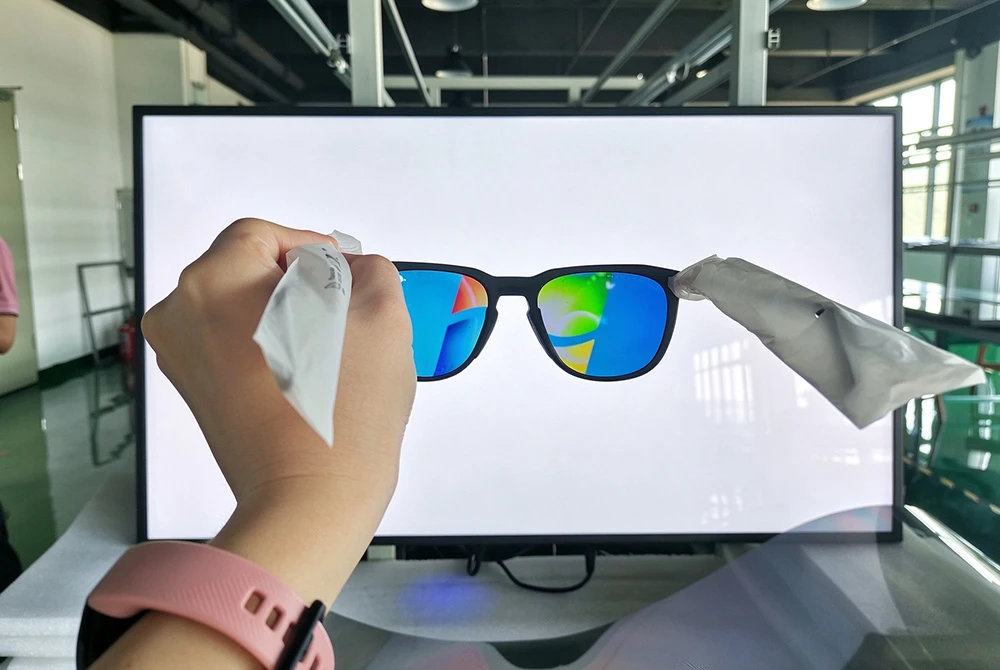
Some non-polarized display designs can offer useful viewing characteristics for specialized applications. For example, compatibility with polarized eyewear may be valuable in marine, aviation, and outdoor equipment.
However, this is a technology-specific benefit, not a universal feature of all no polarizer LCD monitors. Buyers should test the complete display from different viewing angles and through the actual eyewear used in the field.
No Polarizer LCD vs. Conventional LCD: A Cost and Performance Comparison
|
Evaluation factor |
No polarizer LCD |
Conventional LCD |
|---|---|---|
|
Initial cost |
Depends on design and production volume |
Often easier to source in standard formats |
|
Light transmission |
Potential advantage with suitable optical design |
Limited partly by optical-layer losses |
|
Contrast |
Depends on alternative optical structure |
Established performance across many panel types |
|
Power consumption |
May be lower in suitable designs |
Depends on panel efficiency and backlight |
|
Integration |
May need specialized engineering |
Broad ecosystem of standard components |
|
Availability |
Can be more application-specific |
Generally wider selection of sizes and options |
These comparisons are general guidelines, not guaranteed specifications. A well-designed conventional LCD may outperform a poorly matched polarizer-free solution.
Which Applications Benefit Most?
Industrial Equipment and Embedded Systems
Industrial control panels, embedded terminals, and specialized machine interfaces may benefit from alternative display optics when the viewing environment creates specific challenges.
For OEM projects, the best choice depends on the operating temperature, brightness requirements, available installation space, and expected service life. A prototype test can help confirm whether the display meets the equipment's actual needs.
Marine, Aviation, and Outdoor Equipment
Polarized sunglasses can affect how some conventional displays appear, depending on the screen's optical orientation. A display designed for compatibility with polarized eyewear may improve usability for operators who work outdoors or in bright environments.
Nevertheless, sunlight readability also depends on backlight brightness, surface reflections, optical bonding, and ambient light. Removing a polarizer alone does not guarantee outdoor readability.
Specialized OEM and ODM Projects
Custom equipment manufacturers may consider a no polarizer LCD monitor when standard display technology cannot meet a specific optical requirement. In these cases, the benefits should be evaluated across the complete system, including the display panel, driver board, housing, and power supply.
How to Choose the Right Solution
Before placing a bulk order, B2B buyers should follow three practical steps.
Define the performance target. Specify brightness, contrast, viewing angle, color requirements, power limits, and operating conditions.
Request technical samples. Compare the proposed display with a conventional LCD under identical conditions, including bright ambient light and polarized eyewear where relevant.
Calculate total ownership costs. Include development, integration, testing, energy use, maintenance, and replacement availability, not just the initial unit price.
For custom industrial display projects, working with an experienced manufacturer such as Hengstar can help buyers assess panel options, mounting requirements, interface compatibility, and OEM/ODM customization needs before committing to mass production.
Frequently Asked Questions
Are no polarizer LCD monitors cheaper than conventional LCD monitors?
Not always. Removing an optical layer may reduce some material costs, but alternative display technology, specialized manufacturing, and lower production volumes can increase the final price. Compare complete display specifications and total project costs.
Do no polarizer LCD monitors offer better brightness?
They may provide higher light transmission in certain designs, but brightness depends on the optical structure and backlight. Buyers should compare measured luminance and power consumption rather than relying on the absence of a polarizer alone.
Are no polarizer LCD monitors suitable for industrial applications?
They can be suitable for specialized industrial applications when their optical performance matches the operating environment. Buyers should validate contrast, readability, temperature range, durability, and long-term availability before selecting a display for production equipment.
References
Samsung Display, Display Glossary: Polarizer - Overview of polarizers and their role in display optics.
ScienceDirect, Structure and Application of Polarizer Film for Thin-Film-Transistor Liquid Crystal Displays - Research on LCD polarizer structure, properties, and manufacturing.
Hanyang University, Polarizer-Free Liquid Crystal Display Research - Research on alternative liquid crystal technologies.
Hengstar, How Open Frame LCDs Work Without Polarizer - Industrial display considerations and potential applications.