


A waterproof monitor must do more than resist water on its screen. In industrial environments, water can enter through panel joints, touch glass edges, connectors, cables, and rear covers. Poor sealing may lead to display failure, corrosion, unexpected downtime, and costly equipment repairs.
For OEM equipment manufacturers and industrial buyers, understanding waterproof monitor technology helps you select the right product for your application. The key factors include enclosure design, sealing materials, connector protection, touch technology, and verified IP ratings.
How Does Waterproof Monitor Technology Work?
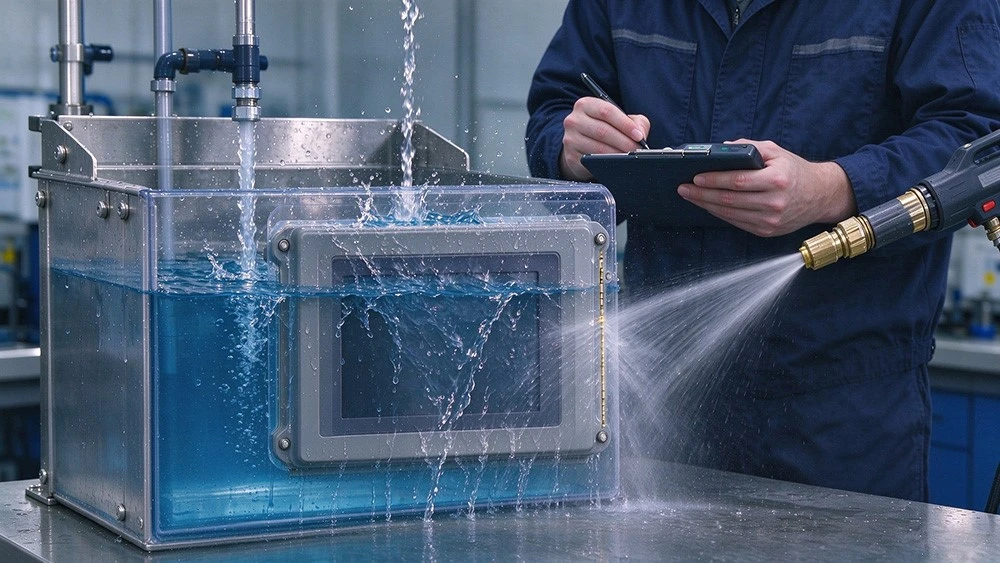
A waterproof monitor works by preventing water and moisture from reaching sensitive electronic components. Instead of relying on one protective material, engineers design several barriers that work together.
Sealed Front Panel and Display Surface
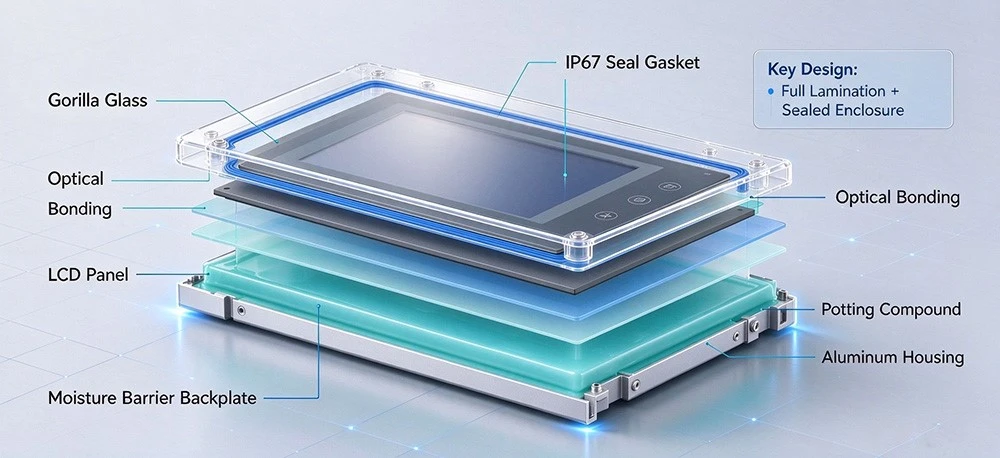
The front panel is often the first area exposed to water, cleaning agents, oil, and dust. A waterproof monitor may use cover glass bonded to the touch panel or display assembly, with a sealed edge that prevents liquid from entering through gaps.
Optical bonding can reduce internal air gaps and improve readability by limiting reflections. However, bonding alone does not make a monitor waterproof. The glass edges, frame, and mounting interface must also be properly sealed.
For equipment installed in wet production areas, buyers should confirm whether the IP rating applies only to the front panel or to the complete monitor.
Waterproof Housing and Enclosure
The enclosure protects the LCD module, control board, power components, and other internal electronics. Its design must prevent water from entering through seams, screw holes, and joints.
A well-designed housing uses carefully fitted panels, suitable gaskets, and controlled fastening pressure. Too little pressure may leave gaps, while excessive pressure can damage the gasket or distort the enclosure.
For OEM projects, the housing must also fit the customer's equipment. Mounting dimensions, cable routing, ventilation, and maintenance access should be considered during the design stage.
Protected Connectors and Cable Entries
Connectors are common points of water entry. Even when the display housing is sealed, an unprotected power or signal connection can compromise the entire system.
Waterproof monitors may use sealed connectors, waterproof cable assemblies, protective caps, or cable glands. The correct solution depends on the installation environment and whether connections must be frequently removed.
Buyers should check whether the stated protection level applies when connectors are connected, disconnected, or covered. They should also confirm that cables and accessories meet the requirements of the complete installation.
What Materials Are Used in Waterproof Monitors?
Material selection affects sealing performance, durability, corrosion resistance, and service life.
Gaskets and Sealing Materials
Silicone, EPDM, and other elastomers are commonly used for seals and gaskets. Each material has different strengths.
Silicone: Offers good flexibility and performs well across a wide temperature range in many applications.
EPDM: Often suits outdoor equipment and applications involving water and weather exposure.
Other engineered elastomers: May be selected when specific oils, cleaning chemicals, or operating conditions require different resistance properties.
The best material depends on temperature, chemical exposure, compression, and expected service life. A gasket suitable for rain may not be suitable for repeated contact with industrial detergents.
Stainless Steel and Aluminum
Stainless steel is useful in wet environments where corrosion resistance and frequent cleaning matter. It is often considered for food processing, medical equipment, and marine applications.
Aluminum offers a lower-weight alternative and can provide good structural strength. With suitable surface treatment, it may be appropriate for industrial machinery, outdoor terminals, and embedded display systems.
The material alone does not determine waterproof performance. Surface finishes, joints, fasteners, and sealing details are equally important.
Cover Glass and Touch Materials
Tempered cover glass can provide a durable front surface and help resist everyday impacts and scratches. Touchscreens may use projected capacitive or resistive technology, depending on the application.
Projected capacitive touch supports multi-touch interaction, but water on the surface may affect input accuracy unless the sensor and controller are designed for wet operation. Resistive touch can suit applications requiring operation with gloves or a stylus, depending on the design.
If operators need to use the screen during cleaning or when droplets are present, ask the manufacturer to verify wet-touch performance separately from enclosure protection.
Understanding IP Ratings for Waterproof Monitors
The IP rating, defined by IEC 60529, indicates how well an enclosure protects against solid objects and water under specified test conditions.
The first digit describes protection against solids, including dust. The second digit describes protection against water.
| IP Rating | General Protection | Typical Application Consideration |
|---|---|---|
| IP65 | Dust-tight and protected against water jets | Industrial equipment exposed to splashes and directed water |
| IP66 | Dust-tight and protected against powerful water jets | Areas requiring stronger water-jet resistance |
| IP67 | Dust-tight and protected against temporary immersion under defined conditions | Equipment that may be temporarily submerged |
| IP69 | Dust-tight and protected against high-pressure, high-temperature water jets under defined conditions | Applications with demanding washdown requirements |
These ratings are not interchangeable. For example, IP67 does not automatically prove resistance to powerful water jets. Always confirm the specific test standard and conditions, especially when high-pressure cleaning is involved.
Also check whether the rating applies to the front face, the rear enclosure, or the entire assembled monitor.
How to Choose the Right Waterproof Monitor for Your Project
Before placing an OEM order, consider the following questions.
What Kind of Water Exposure Will the Monitor Face?
Identify whether the monitor will encounter occasional splashes, continuous rain, regular hose cleaning, high-pressure washdown, or temporary immersion. This helps determine the appropriate protection level without unnecessary cost.
Will the Monitor Contact Chemicals or Experience Temperature Changes?
Cleaning agents, oils, saltwater, and temperature cycling can affect seals and housing materials. Share the actual operating conditions with your supplier so materials can be selected and tested accordingly.
Can the Monitor Be Integrated Into Your Equipment?
Check screen size, mounting method, bezel dimensions, connector position, cable length, operating temperature, and touch requirements. A front-sealed open-frame monitor may be suitable when the customer's cabinet provides rear protection. A fully sealed unit may be necessary when the entire monitor is exposed.
Can the Manufacturer Verify Its Waterproof Claims?
Request test reports for the exact model and configuration. Confirm that the tested assembly includes the relevant seals, connectors, cables, and mounting arrangements. Changes to any of these components may affect the final protection level.
Why OEM Design Matters for Waterproof Monitors
For industrial equipment manufacturers, waterproof performance must be considered from the beginning of product development. Retrofitting seals onto a standard monitor may not provide the same reliability as a design developed for a wet environment.
Hengstar, a China-based industrial computer manufacturer founded in 2004, provides OEM/ODM services for overseas brands and equipment manufacturers. Customization can address display size, housing structure, touch technology, mounting options, interfaces, and operating requirements.
By defining the application environment and verification requirements early, buyers can work with the manufacturer to develop a waterproof monitor that balances protection, integration, durability, and cost.
The most reliable choice is not necessarily the monitor with the highest IP rating. It is the one whose materials, sealing structure, and verified performance match the conditions in which it will operate.
Frequently Asked Questions
Can a waterproof monitor be used outdoors?
Yes, if its design meets the outdoor environment requirements. In addition to water protection, buyers should consider sunlight readability, UV exposure, temperature range, corrosion resistance, and condensation.
Does an IP65 monitor support immersion in water?
No. IP65 indicates dust-tight protection and resistance to water jets under defined test conditions. It does not establish suitability for immersion. A different rating and verification may be required.
What is the most important material in a waterproof monitor?
There is no single most important material. Gaskets, housing materials, cover glass, connectors, and cable seals all contribute to protection. The right combination depends on the application, cleaning chemicals, temperature, and expected water exposure.
References
International Electrotechnical Commission (IEC). IEC 60529: Degrees of Protection Provided by Enclosures (IP Code). https://www.iec.ch/ip-ratings
Panasonic Professional Displays. Glossary: IP Rating. https://docs.connect.panasonic.com/prodisplays/support/glossary/
Orient Display. The Analysis of Waterproof Requirements for Touch and Displays. https://orientdisplay.com/the-analysis-of-waterproof-requirements-for-touch-and-displays/