


In recent years, embedded industrial control computers have become increasingly mature in their applications and have begun to replace traditional industrial control computers in some fields. With the development of embedded technology, the application of embedded industrial control computers is becoming increasingly widespread and has become a trend in the development of industrial control computers. So what are the differences between embedded industrial computers and traditional industrial computers?
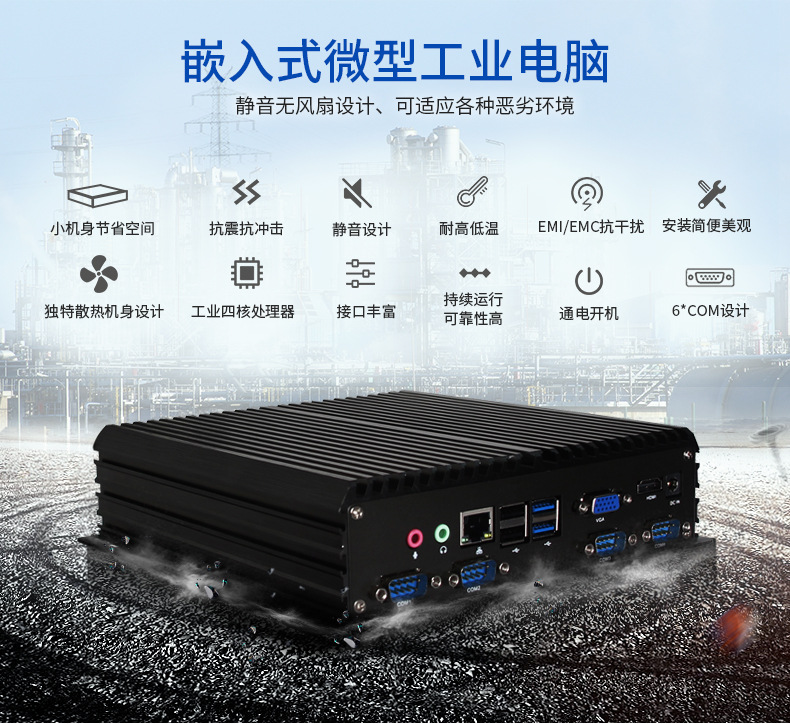
Traditional industrial control computers generally use standard 4U chassis that is easy to install. The chassis is made of steel structure and has high anti electromagnetic interference and anti impact capabilities. There is a dedicated power supply inside the chassis, which has the ability to work continuously for a long time. The chassis requires a fan for cooling, and when the fan fails, it can cause damage to the power supply and industrial motherboard. The embedded industrial control computer adopts a sealed fanless design, which not only can prevent dust, moisture, vibration, and enhance the ability to resist electromagnetic interference, but also can achieve wide temperature operation.
The embedded industrial control computer uses heat sinks distributed on the surface of the chassis for heat dissipation, effectively solving the problem of high internal temperature and easy failure of the cooling fan when working for a long time, and improving the stability and reliability of the industrial control computer during long-term operation on site. At the same time, the fanless operation avoids the requirement of air convection, effectively preventing dust from entering the interior of the industrial computer. All circuits are firmly fixed inside the industrial computer using circuit boards, ensuring stable and reliable operation even in extremely harsh environments such as high temperature, high-frequency vibration, and high dust
DC wide voltage input
The built-in industrial standard voltage and current regulator supports DC wide voltage input, providing safe and reliable operation in various industrial environments.
2, Different functions
Embedded industrial control computer is a compact industrial control computer designed for use in various narrow spaces. It has a compact size, small volume, light weight, occupies less space, is easy to install and maintain, flexible, and easy to operate. Supports various expansion interfaces such as PCI, PCIE, mini PCIe, and mSATA, providing maximum flexibility for different industrial applications. The high-performance embedded industrial computer also supports POE ports, allowing data to be transmitted through Ethernet cables, making the system compatible with IEEE802.3af standard power devices, reducing complexity, installation and maintenance costs, while increasing network security and reliability.
3, Usage cycle
Embedded industrial control computers are often organically combined with specific applications, and the upgrading and replacement of embedded industrial control computers are also synchronized with specific products. Therefore, once embedded system products enter the market, they have a long service life.
Traditional industrial control computers have a wide and solid user base, and their system composition is highly flexible, which has been familiar and recognized by a large number of technical personnel. Embedded industrial control computers take up less space and are suitable for applications that require higher reliability, size, and power consumption. Both have their own strengths, and compared with traditional industrial computers, embedded industrial computers are more suitable for complex and harsh on-site environments. At present, embedded industrial control computers have been widely used in fields such as industrial automation, intelligent transportation, networking, communication, medical equipment, vehicle mounted devices, power, financial monitoring, machine vision, and video surveillance.
