


Two rugged tablets can carry different IP ratings and still be suitable for the same job. They can also carry the same rating and behave differently once scanners, docks, or cleaning chemicals are involved. Understanding IP ratings in rugged tablet computers helps buyers identify what a rating proves and what still needs checking.
For procurement, the aim is to select reliable equipment without paying for protection the application does not require. For technical teams, it is to confirm that the test conditions and device configuration support the claimed performance. Both decisions begin with the actual working environment.
What an IP Rating Tells You About a Rugged Tablet
An IP rating describes protection provided by an enclosure. IEC 60529 defines the classification and associated tests. The first main digit relates to solid objects and dust; the second relates to water. [1]
In IP65:
- 6 means dust-tight under the specified test.
- 5 means protection against water jets under the specified test.
An X means that a level is not specified in that position. For example, IPX7 gives a water classification without establishing a dust rating.
For a buyer, the useful distinction is simple: IP65 and IP66 cover jets; IP67 covers temporary immersion; IP68 covers immersion under stated conditions more severe than IPX7. [2][3]
The rating applies to the enclosure as assessed. It is not a complete statement about drops, screen visibility, software reliability, or every accessory connected to the tablet.
IP65 vs. IP66 vs. IP67 vs. IP68 Rugged Tablets
The four ratings below share dust-tight protection. Their water tests address different exposures.
|
Rating |
What it establishes |
When to consider it |
What to confirm |
|
IP65 |
Dust-tight enclosure and water-jet protection |
Dusty work with water exposure within the product's documented limits |
Port conditions and approved cleaning |
|
IP66 |
Dust-tight enclosure and powerful-jet protection |
Applications requiring stronger jet resistance |
Actual cleaning pressure, temperature, and method |
|
IP67 |
Dust-tight enclosure and temporary-immersion protection |
Accidental immersion within the tested limits |
Depth, duration, and separate jet evidence |
|
IP68 |
Dust-tight enclosure and immersion under specified conditions |
A project needs immersion conditions beyond IPX7 |
Exact immersion specification and permitted use |
These are starting points for evaluation, not approval for every environment in the same industry.
Why a Higher Water Number Is Not Always the Better Purchase
IP67 and IP68 are not automatic upgrades to IP66 for hose cleaning. Immersion and jets are separate tests. Schneider Electric confirms that products marked with both IP66 and IP67 have undergone the different assessments. [4]
Consider a utility tablet that could fall into shallow water and is also cleaned with a hose. An immersion result addresses the first exposure. It does not, by itself, establish jet protection for the second.
If both matter, specify both and request the supporting results. A dual marking such as IP66/IP67 communicates more than an unrestricted "waterproof" claim.
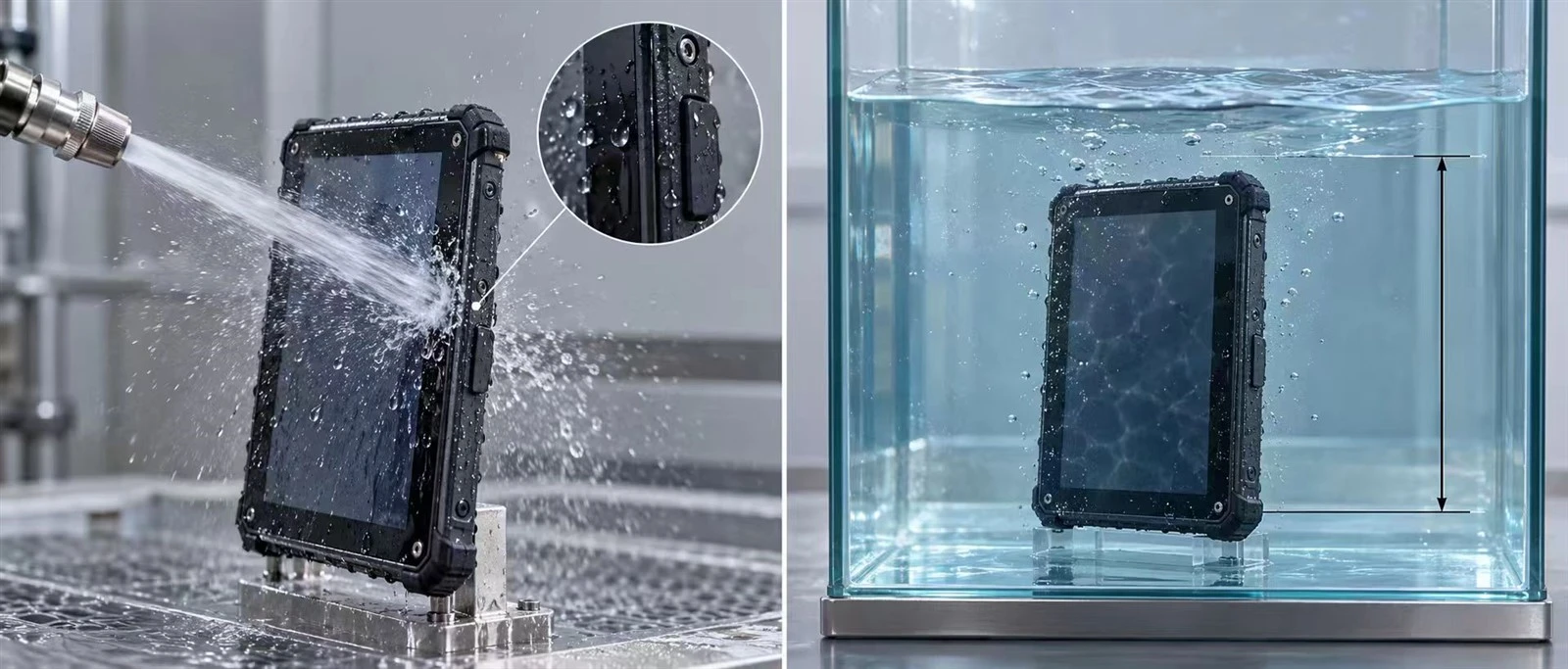
What the Laboratory Tests Actually Involve
The test details matter because ordinary use rarely reproduces one laboratory exposure exactly.
Dust: A Controlled Chamber Test
IP6X is assessed using circulating test dust and controlled air extraction from the enclosure. EMCTEST describes 2 kg of talcum powder per cubic meter of chamber volume, with pressure reduction limited to 2 kPa. Duration depends on the extraction conditions. [2]
The purchasing implication is that "dust-tight" should be backed by a defined test and internal inspection, not a photograph of a device covered in dust.
For engineering review, confirm the medium, duration, extraction conditions, and findings. Abrasive sand and damage to exposed contacts are separate concerns from dust entering the main enclosure.
Water Jets: Flow, Distance, and Duration
IPX5 uses a 6.3 mm nozzle at 12.5 L/min. IPX6 uses a 12.5 mm nozzle at 100 L/min. The tests also prescribe distance and exposure requirements, with a minimum duration of three minutes. [3]
This explains why a jet rating does not authorize any pressure washer. Hot water, a different nozzle, or a closer cleaning distance can create a different exposure.
The supplier's approved cleaning method should match the site procedure. Where high-temperature, high-pressure cleaning is required, discuss the relevant test standard and chemical compatibility separately.
Immersion: State the Depth Reference
For IPX7, a typical tablet-sized enclosure is tested for 30 minutes with its lowest point 1 meter below the water surface. [2]
For IPX8, obtain the product's specified depth and duration. A useful description also identifies the tablet configuration, orientation, and operating state.
An immersion result does not automatically permit underwater operation. If the application requires the display, touch input, or other functions to work underwater, state that requirement separately.
What Does "Passed" Mean After Water Exposure?
A tank or spray photograph shows the exposure. The report should show the assessment.
Water protection generally concerns harmful effects from ingress. Keystone Compliance explains that some enclosures can meet requirements despite limited entry, depending on the product and its acceptance criteria. [3]
- For buyers, this means a pass should answer the business question: can the device return to the required task under agreed conditions?
- For a tablet inspection project, additional acceptance checks might cover:
- Display and touch operation.
- Scanner and communication interfaces.
- Stored data remaining intact.
- Battery contacts and critical electronics.
- Charging after the approved drying procedure.
These are proposed project checks, not a claim that IEC 60529 requires every item.
Agree when the checks take place and whether drying or recovery is allowed. Immediate return to work and recovery after several hours are different operational requirements.
Check Protection in the Configuration Workers Will Use
A tablet tested with covers closed may be used with a USB scanner attached. A removable battery may be changed outdoors. A dock may introduce exposed connections.
Before ordering, confirm whether the documented rating covers:
- Open or closed connector doors.
- Connected cables and the specified accessories.
- The selected battery and secured battery cover.
- The intended docking and charging arrangement.
Zebra's L10 Android specification states IP65 with port doors open or closed. This is a useful model-specific detail; it should not be assumed for other devices. [5]
The tablet's report also does not establish the dock's protection. Evaluate each exposed part of the working setup.
For OEM changes, ask whether a revised connector, scanner window, or battery housing is covered by existing evidence. If not, agree on the review or testing needed before production approval.
Sealing Quality Depends on the Complete Enclosure
A rugged tablet has multiple joints and openings. Housing seams, display bonds, battery covers, buttons, and acoustic openings all need to be considered.
Technical teams should request a configuration record that identifies sealing parts, service openings, and closure instructions. For procurement, this provides a practical reference for spare parts and future repairs.
Pressure changes are another design consideration. Gore explains that suitable protective vents can equalize pressure and reduce stress on seals while blocking contaminants. [6]
A vent's own rating does not qualify the assembled tablet. Its selection and installation need to be assessed as part of the enclosure.
After damage or repair, follow the supplier's inspection procedure. A replaced cover or opened bonded joint can change the condition originally tested.
Separate IP Protection from Other Environmental Requirements
A high IP rating does not establish chemical resistance, drop endurance, salt-fog performance, or the full operating temperature range.
Write these as separate requirements:
|
Requirement |
Procurement needs to know |
Technical review should confirm |
|
Drop resistance |
Likely drop height and impact surface |
Method, orientations, sample condition, and result |
|
Cleaning compatibility |
Agents and daily cleaning frequency |
Concentration, contact time, materials, and procedure |
|
Cold-room use |
Temperature transitions and condensation |
Humidity limits and relevant configuration |
|
Outdoor operation |
Readability and input in rain or gloves |
Display and touch performance under agreed conditions |
Zebra lists IP66 separately from humidity performance for the ET60/ET65, distinguishing its standard and freezer configurations. This shows why condensation needs its own review. [7]
Also check test sequence. Separate drop and ingress results do not prove that protection remains after a drop. Where this matters, agree on sequential testing of the relevant configuration.
Buying a Tested Design-and Keeping Production Consistent
A successful sample is important, but the order may include hundreds of units. The delivered products need to remain consistent with the approved design.
For an OEM rugged tablet project, record:
- Approved enclosure and sealing-component revisions.
- Assembly and closure instructions.
- Changes requiring review or retesting.
- Inspection records and traceability.
- Repair and replacement-seal procedures.
If the factory uses a leakage screen, ask how its method and limits were validated against the required protection. Treat that screen as a production control, not a substitute for the qualification test.
This discussion also prevents a common documentation problem: a test report for an earlier version being used to support a changed product.
A Practical Way to Review Supplier Evidence
Procurement can collect the documents; the technical team can assess the details. Both should be able to link the report to the product being ordered.
Check five items:
1. Product identity: model, enclosure revision, battery, accessories, and sample number.
2. Test method: standard edition, conditions, duration, orientation, and operating state.
3. Result: inspection findings, acceptance criteria, functional checks, and deviations.
4. Scope: protection claims and configurations actually covered.
5. Laboratory status: where accreditation is required, the relevant method must fall within the laboratory's scope.
Eurofins MASER describes internal and external inspection and reports with photographs of test setups and results. Buyers can request this level of supporting detail. [8]
An accreditation logo or short certificate is useful context, but it does not answer whether the report covers the ordered configuration.
Turning the Requirement into a Supplier Discussion
Start with the exposure and workflow: what water contact is expected, which ports stay connected, how the tablet is cleaned, and how quickly it must resume service. Then agree on the configuration and evidence needed.
Hengstar supports customized rugged tablet projects, including configurations developed for IP68 requirements. The selected model, immersion conditions, and supporting documentation should be confirmed during technical review.
For specification discussions, sample evaluation, or pricing, contact Hengstar or submit an enquiry.
Email: sales@angeltondal.com
Phone / WhatsApp: +86 13923773785. [9]
FAQs About IP Ratings in Rugged Tablet Computers
1. Is IP68 always better than IP66?
IP68 addresses specified immersion conditions; IP66 addresses powerful jets. Select by exposure.
2. Does a water-test pass mean the enclosure stayed completely dry?
Not necessarily. Read the acceptance criteria and internal inspection findings.
3. What should an IP68 claim include?
Specified depth, duration, configuration, operating state, and supporting test evidence.
4. Can workers use the tablet with open ports?
Only if the documented protection covers that condition. Review connected cables as well.
5. Does the rating remain valid after a drop or repair?
Separate test results do not establish post-drop protection. Repairs also require the supplier's checks.
6. Does IP protection include cleaning chemicals?
No. Verify approved agents, concentrations, contact times, and cleaning procedures separately.
References
1. IEC - IEC 60529: Degrees of Protection Provided by Enclosures.
2. EMCTEST - IP6X Dust and IPX7 Immersion Test Methods.
3. Applus+ Keystone - EN/IEC 60529 IP Code Testing.
4. Schneider Electric - Why Some Products Have Both IP66 and IP67 Ratings (Swedish).
5. Zebra - L10 Android Rugged Tablets Specification Sheet.
6. Gore - Protective Vents: Technical FAQ.
7. Zebra - ET60/ET65 Enterprise Tablets Specification Sheet.