


Industrial displays are often used in environments where dust, water, oil, humidity, and frequent cleaning are part of daily operations. Unlike ordinary commercial monitors, industrial displays must maintain stable performance under challenging conditions. Without proper waterproof protection, moisture can enter the enclosure, damage electronic components, affect touch functions, and shorten the product's service life.
For OEM equipment manufacturers, system integrators, and industrial display distributors, choosing the right protection level is not simply a technical decision. It directly affects equipment reliability, maintenance costs, and long-term operating performance.
Understanding IP ratings, waterproof design, and application requirements can help buyers select the right industrial display for their projects. This guide explains why waterproof protection matters, how different IP ratings work, and what buyers should consider when sourcing industrial waterproof monitors.
Why Do Industrial Displays Need Waterproof Protection?
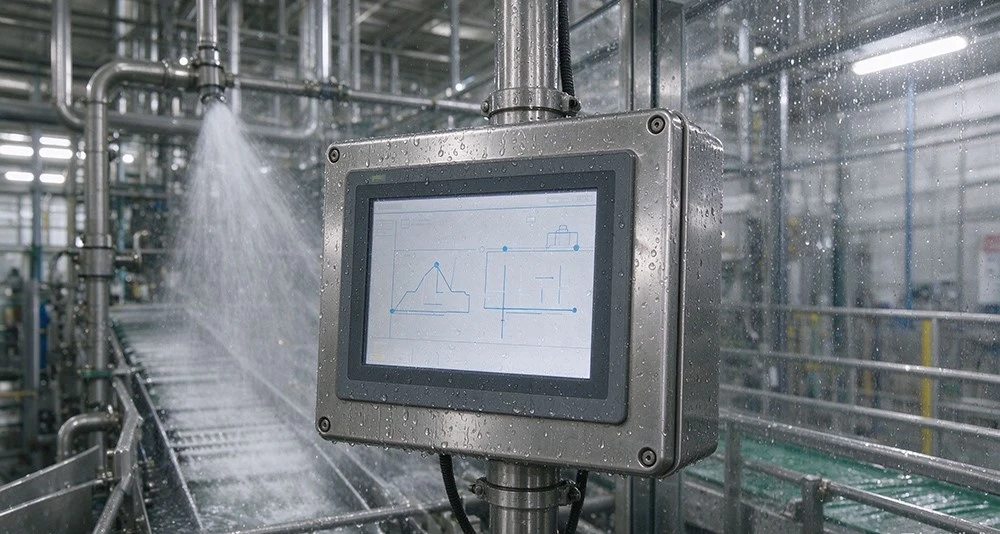
Industrial displays are frequently installed in places where exposure to liquids cannot be avoided. Manufacturing plants, food processing facilities, marine equipment, and outdoor control systems all present different environmental challenges.
Protection Against Water and Moisture
Water can enter a display through gaps around the screen, buttons, connectors, cable openings, or enclosure joints. Once moisture reaches internal electronic components, it may cause short circuits, corrosion, unstable operation, or permanent hardware failure.
Even when a display is not directly exposed to water, high humidity and condensation can create long-term problems.
A waterproof industrial monitor uses suitable enclosure structures, sealing materials, and protected interfaces to reduce the risk of water entering the system.
Better Resistance to Dust, Oil, and Contaminants
Waterproof protection is often closely related to dust protection. In industrial environments, fine particles, oil mist, and other contaminants can collect around display openings and affect internal components.
A properly sealed industrial display helps prevent these materials from entering the enclosure, supporting more stable operation and reducing cleaning and maintenance requirements.
Improved Reliability and Longer Service Life
Replacing a damaged industrial monitor can involve more than the cost of a new display. Equipment downtime, labor, system testing, and production interruptions can create additional expenses.
Selecting an industrial display with an appropriate IP rating helps reduce environmental risks and supports more predictable equipment operation.
What Is an IP Rating for Industrial Displays?
IP stands for Ingress Protection. It is an international classification system defined by IEC 60529. It describes how effectively an electrical enclosure protects against the entry of solid objects and water.
An IP rating normally consists of two digits:
- First digit: Protection against solid objects, including dust.
- Second digit: Protection against water.
For example, IP65 and IP67 are common protection levels considered for industrial displays and panel PCs.
Understanding the First Digit: Dust Protection
The first number indicates protection against solid particles.
|
Rating |
Protection Level |
Meaning |
|---|---|---|
|
IP5X |
Dust-protected |
Dust entry is limited and does not interfere with operation |
|
IP6X |
Dust-tight |
No dust ingress under the specified test conditions |
For industrial environments with airborne dust, metal particles, or powder, IP6X protection is often a suitable consideration.
Understanding the Second Digit: Water Protection
The second number indicates resistance to water exposure.
|
Rating |
Water Protection |
Typical Test Condition |
|---|---|---|
|
IPX3 |
Spraying water |
Water spray up to 60° from vertical |
|
IPX4 |
Splashing water |
Water splashed from different directions |
|
IPX5 |
Water jets |
Water jets from a nozzle |
|
IPX6 |
Powerful water jets |
More powerful water jets |
|
IPX7 |
Temporary immersion |
Immersion up to 1 meter for 30 minutes |
|
IPX8 |
Continuous immersion |
Immersion under conditions specified by the manufacturer and testing agreement |
One important point for buyers: IP67 does not automatically mean better protection against water jets than IP65 or IP66. These ratings describe different test conditions.
Which IP Rating Is Suitable for Different Industrial Applications?
Not every industrial display requires the same level of waterproof protection. Buyers should select an IP rating based on the actual working environment, cleaning methods, and installation conditions.
IP65: Suitable for Dusty and Wet Environments
IP65 provides complete dust protection and resistance to water jets from different directions under specified test conditions.
It is commonly considered for:
- Factory production lines
- Industrial automation equipment
- Packaging machinery
- Control cabinets
- General manufacturing environments
For equipment exposed to occasional water spraying or routine surface cleaning, IP65 can be a practical option.
IP66: Better Protection Against Powerful Water Jets
IP66 provides dust-tight protection and resistance to powerful water jets.
It is worth considering for:
- Food and beverage production equipment
- Industrial washing areas
- Outdoor control systems
- Machinery exposed to heavy splashing
- Industrial environments requiring frequent cleaning
However, IP66 does not automatically mean the display can withstand every high-pressure cleaning process. Water pressure, temperature, nozzle distance, and cleaning chemicals must also be considered.
IP67: Protection Against Temporary Water Immersion
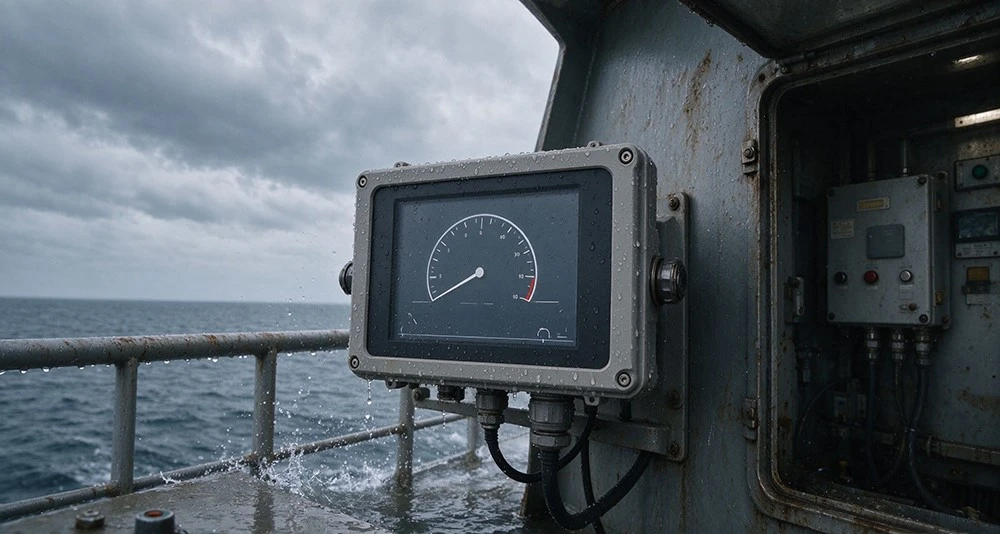
IP67 provides dust-tight protection and protection against temporary immersion under specified test conditions, commonly up to 1 meter for 30 minutes.
Typical applications include:
- Marine control equipment
- Outdoor industrial terminals
- Equipment installed in areas with temporary flooding risks
- Special-purpose industrial machinery
For buyers, it is important to distinguish between temporary immersion and continuous underwater operation. IP67 should not be treated as a guarantee of permanent underwater use.
How Does Waterproof Design Improve Industrial Display Performance?
A high IP rating is not achieved by simply adding a waterproof cover. It requires a complete enclosure design that considers every possible entry point.
Sealed Enclosure and Waterproof Structure
The front panel, rear cover, screen edges, and enclosure joints must work together to prevent water and dust from entering.
Common design solutions include:
- Silicone or rubber sealing gaskets
- Waterproof bonding and sealing materials
- Tight-fitting enclosure structures
- Corrosion-resistant housing materials
- Protected cable openings and interfaces
The quality of the enclosure assembly is just as important as the materials themselves.
Waterproof Connectors and Cable Interfaces
Connectors are often one of the weakest points in an industrial display's waterproof design.
Standard HDMI, USB, and power connectors may allow moisture to enter if they are not properly protected. For demanding applications, manufacturers can provide waterproof connectors, sealed cable assemblies, and customized interface solutions.
Buyers should check whether the stated IP rating applies to the complete assembled product, including connectors and cables, or only to the front panel.
Touchscreen Protection
Industrial touchscreens must remain responsive even in environments with water splashes or frequent cleaning.
Projected capacitive (PCAP) touchscreens are widely used in industrial applications. However, water on the screen surface can sometimes cause false touches or affect touch accuracy.
For wet environments, buyers should discuss touch controller settings, glove operation, water rejection, and screen sealing with the manufacturer.
What Should Buyers Check Before Purchasing a Waterproof Industrial Display?
When sourcing a waterproof industrial monitor or panel PC, buyers should look beyond the IP rating printed on the product specification sheet.
Confirm the Actual Protection Scope
Some products offer IP65 protection only on the front panel, while the rear enclosure and connectors have lower protection levels.
Before placing an order, confirm:
- Is the entire unit waterproof or only the front side?
- Are the power and signal connectors protected?
- Does the rating apply after installation?
- Are mounting brackets and cable connections included in the test configuration?
These details can prevent unexpected problems during equipment integration.
Check Certifications and Test Reports
A reliable industrial display manufacturer should be able to provide supporting technical documents.
Ask for IP test reports based on IEC 60529, product specifications, and relevant quality inspection records. For projects requiring additional environmental protection, buyers may also need corrosion resistance, temperature testing, or vibration testing.
Remember that IP ratings do not automatically guarantee resistance to chemicals, salt spray, extreme temperatures, or mechanical impact.
Consider Customization for OEM Projects
Different equipment manufacturers have different requirements. A standard waterproof monitor may not fit every machine structure or operating system.
OEM buyers may need customized screen sizes, brightness levels, touchscreen types, mounting methods, operating systems, and waterproof interfaces.
Working with a manufacturer that provides engineering support and OEM/ODM services can make it easier to develop a display that matches the complete equipment design.
How Hengstar Supports Waterproof Industrial Display Projects
As a China-based industrial computer manufacturer established in 2004, Hengstar provides OEM/ODM services for overseas brands, equipment manufacturers, and system integrators.
Our industrial display solutions can be customized according to project requirements, including:
- Different screen sizes and display resolutions
- IP65/IP67 protection design options
- Waterproof connectors and cable solutions
- Capacitive or resistive touchscreen options
- Windows, Android, and Linux platforms
- Panel mounting, VESA mounting, and customized structures
- Brightness and interface customization
For example, Hengstar's 21.5-inch waterproof panel PC can be configured with a 1920 × 1080 resolution, 10-point capacitive touch, and optional 450-nit or 1000-nit brightness. Its waterproof design includes IP65 connectors and a structure intended for demanding industrial applications.
For OEM buyers, the key is to define the required protection level, installation method, and operating conditions before production. This helps ensure that the final display meets the needs of the complete equipment system.
Conclusion
Waterproof protection is an important factor in industrial display selection. It helps protect electronic components from water and dust, reduces environmental risks, and supports reliable operation in demanding workplaces.
However, choosing the right IP rating requires more than comparing numbers. Buyers should understand the difference between IP65, IP66, and IP67, check the protection scope of the complete device, and consider actual operating and cleaning conditions.
By working with an experienced industrial display manufacturer such as Hengstar, OEM buyers can develop customized waterproof display solutions that meet their equipment requirements and long-term business goals.
References
IEC 60529 – Degrees of Protection Provided by Enclosures (IP Code)
ABB – Pilot Devices Guide: Protection Degrees of Enclosures
Zebra – What Is an IP Rating?
IEC 60529 – IP Code Classification and Protection Requirements